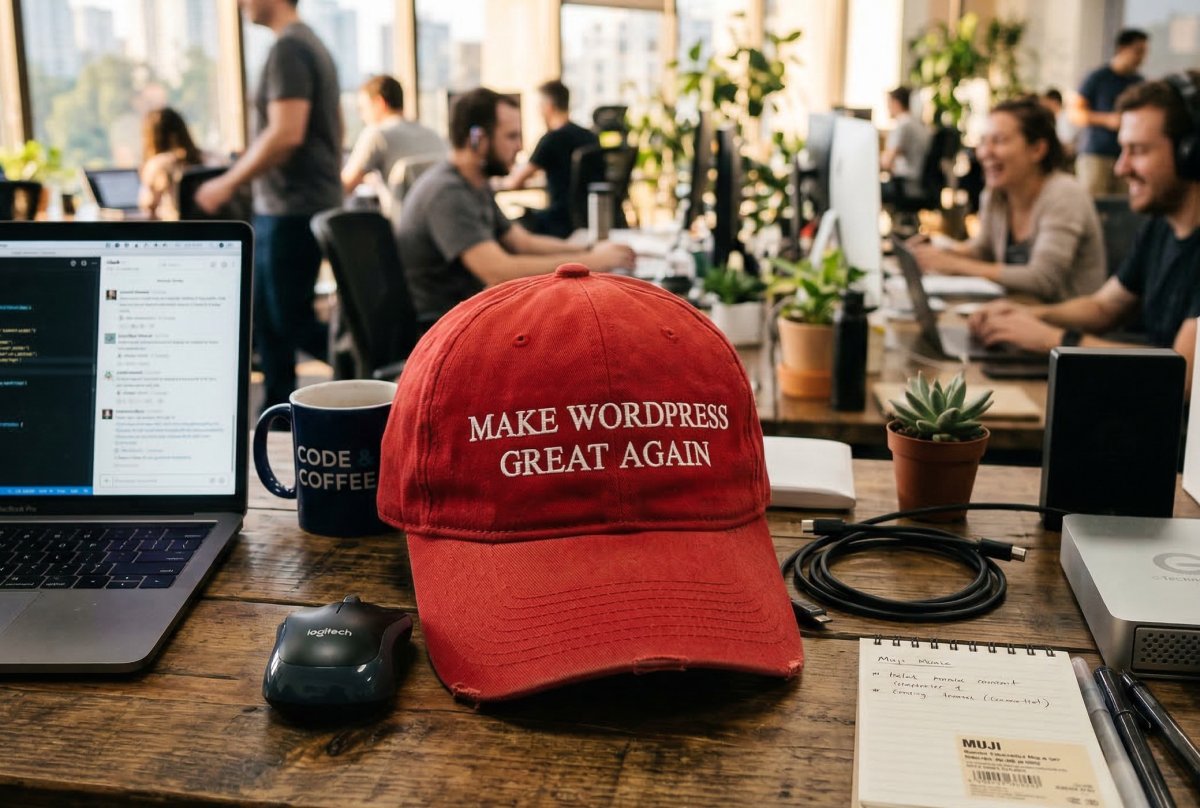
I wasn't entirely sure what to call this post. But I did know what I wanted to talk about: chaos. I considered calling it Make WordPress Great Again, a nod to that well-known figure we all recognize. And honestly, it wouldn't be a bad tagline either.
It's estimated that 43% of all websites run on WordPress. 600 million pages. And if you've ever worked at an agency that builds or advises clients using WordPress, you know there's a less glamorous side to that statistic. Because nobody works with vanilla WordPress.
The first thing anyone does after installing this CMS is start piling on plugins like there's no tomorrow. Many are useful — a great many, in fact. But there are others that do your system no favors whatsoever. Some try to do far too much, quietly devouring resources over time. Others end up locking in your development choices for years, even though you're technically using open-source software.
Then there's the passage of time. Those sites that have passed through the hands of multiple administrators. Installations with code that nobody can trace or fully explain. Dozens of plugins that haven't been updated in ages, but that bring everything crashing down the moment you deactivate them. It's like a Jenga tower that's grown too tall. You know it's going to fall at some point. And any small move might be the one that brings it down.
That's where we come in. RakuWP. In Japanese, raku can be translated as "comfortable" or "easy." And that's exactly what we want WordPress to be.
We don't want to be just another plugin. We want to be the plugin.
One that does many things, and does them well enough to serve at least 80% of those 600 million sites running this CMS. We probably won't be the best plugin for every individual feature, but we will be solid, simple, and efficient enough to cover most real-world needs.
To get there, we've built a modular system. Once installed, almost everything can be toggled on or off from a dashboard via simple switches. Each module operates independently, so if one fails, it won't take the others down with it.
We're also working to make everything — or nearly everything — manageable remotely from our control panel, including our own plugin and any others you might have installed. And, as you'd expect in 2026, we're integrating AI too. But we don't want to be one of those companies that shoehorns artificial intelligence into every settings menu. We want it there when it makes sense: to help you, to save you time, and to simplify your workflow.
We're launching with a free version, but we hope many users will find enough value to move to the paid tier. Our pricing is highly competitive. When you add up the cost of maintaining several separate plugins, you'll likely find that RakuWP doesn't just simplify your stack — it makes it cheaper too. We're starting with around ten services, but we have a roadmap full of new features and improvements ahead.
This is only the beginning. And if WordPress powers 43% of the internet, we believe there's still plenty of room to make it simpler, more stable, and easier to work with.
